- Wing loading formula
- Checking battery voltages
- gas/oil mixing ratio table
- cubic inches vs cubic centimeters table
- two stroke tuning instructions
- build an accurate windspeed meter
- epoxy mix pads
Ever wonder how to figure wing loading? Here is the simple formula: aircraft weight (in ounces) x 144 divided by the wing area in square inches. This will tell you the wing loading of your model.
Mixing ratio chart for gas/oil mix fuel, print a copy for your flight box.
Click here
for a printable copy.
| Ratio | Ounces | Ratio | Ounces |
|---|---|---|---|
| 100:1 | 1.28 | 80:1 | 1.6 |
| 70:1 | 1.83 | 60:1 | 2.13 |
| 50:1 | 2.56 | 40:1 | 3.2 |
| 30:1 | 4.27 | 25:1 | 5.12 |
| 20:1 | 6.4 | 10:1 | 12.8 |
Here is a reference chart for cubic inches vs cubic centimeters.
Click here
for a printable copy.
| inches | Centimeters | Inches | Centimeters |
|---|---|---|---|
| .25 ci | 4 cc | .32 ci | 5.2 cc |
| .40 ci | 6.5 cc | .45 ci | 7.4 cc |
| .61 ci | 10 cc | .75 cu | 12.3 cc |
| .91 ci | 14.9 cc | 1.20 ci | 19.8 cc |
| 1.50 ci | 24.6 cc | 1.80 ci | 29.5 cc |
| 2.0 ci | 32.3 cc | 2.14 ci | 35 cc |
| 2.4 ci | 40 cc | 3.1 ci | 50 cc |
| 3.8 ci | 62 cc | 6.1 ci | 100 cc |
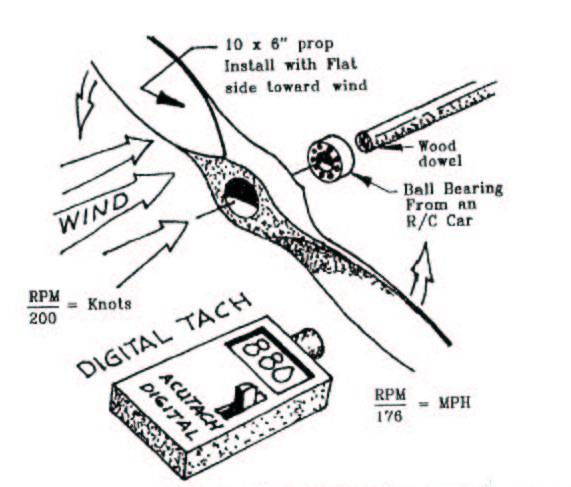
If you have a digital tachometer, dowel rod, 10x6 prop and a bearing, you can build a simple wind speed meter that works well. See the illustration below. To make calculations easier, you can print a list of RPM's vs wind speed.
A neat re-usable epoxy mixing pad is any plastic lid. Example, Pringles can lids are just about the right size. You can mix your epoxy without it running off the edge and when cured, simply flex and throw whats left away. And it is ready to use again.